
Brow Lift Is Not Defined by Age Alone
When people think about brow lift surgery, they often associate it with older patients experiencing significant forehead laxity or age-related brow descent.
However, age alone does not determine whether someone may consider a brow lift.
Facial anatomy, natural eyebrow position, asymmetry, forehead structure, the relationship between the brows and upper eyelids, and individual aesthetic concerns can all influence the appearance of the upper face—even in younger adults.
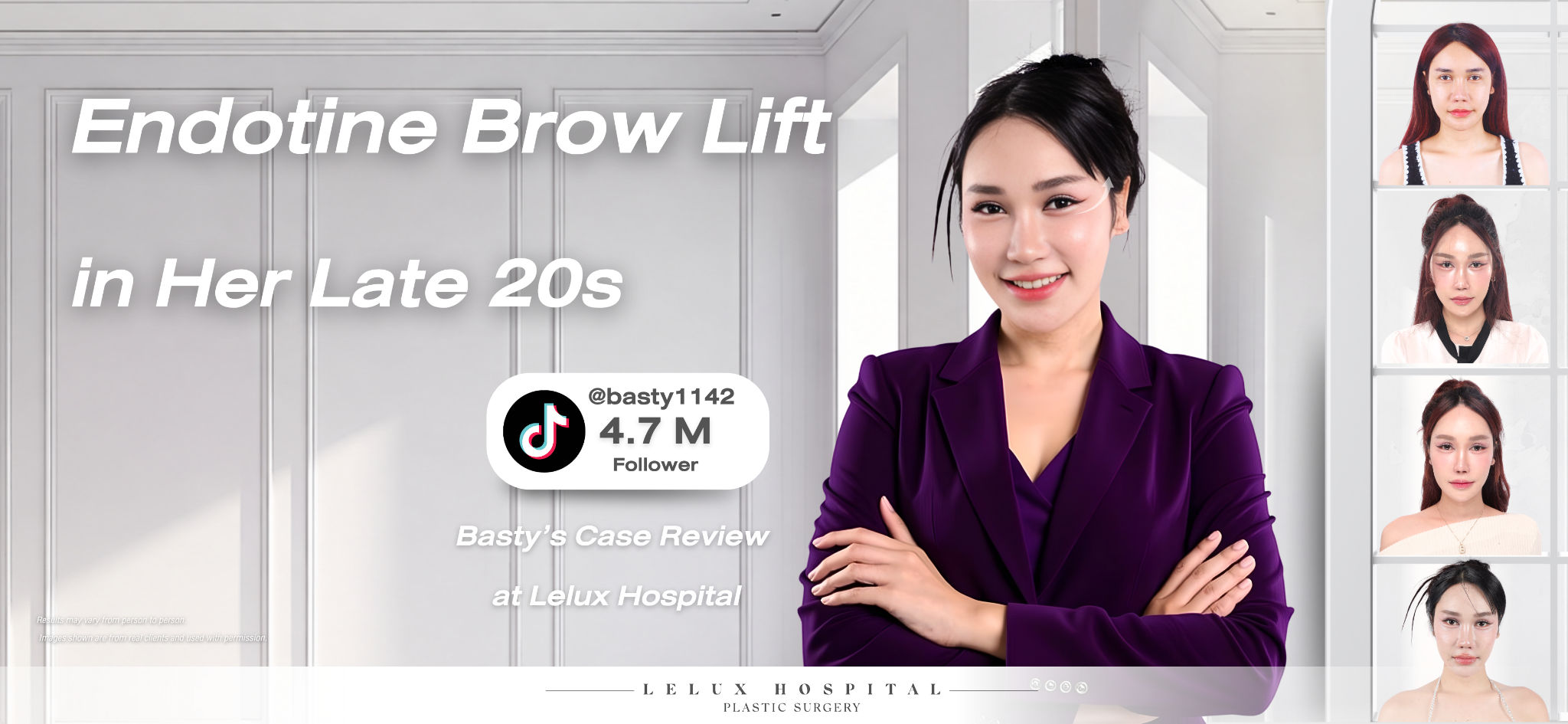
This case follows Basty (Thitikorn Jaemjaeng), a Thai influencer and content creator in her late 20s who chose to undergo brow lift treatment at Lelux Hospital in Thailand.
Rather than focusing primarily on advanced signs of facial aging, her case illustrates how brow lift treatment may also be considered in relation to brow position, upper-eye openness, facial proportions, and overall upper-facial balance.
In younger adults, brow lift surgery is considered based on individual anatomy and upper-facial proportions rather than age alone. A personalized assessment helps determine whether surgical repositioning is appropriate for the patient’s specific concerns.
Why Might Someone in Their Late 20s Consider a Brow Lift?
Not everyone who considers a brow lift has significant age-related sagging.
For younger adults, concerns may be related more to natural facial anatomy and brow position than to the aging process itself.
Some individuals may naturally have:
- Low-positioned eyebrows
- A lower outer brow
- Uneven eyebrow height
- Heaviness around the upper eyelids
- Limited visible upper-eyelid space
- A brow position that makes the eyes appear less open
- Differences between the two sides of the upper face
These characteristics may be present from a relatively young age.
In some people, the position of the brows may contribute to a tired, serious, or less open appearance around the eyes even when the skin itself remains relatively firm.
The decision to consider brow lift surgery should therefore be based on facial anatomy, the degree of concern, available treatment options, general health, and realistic expectations.
Basty’s Endotine Brow Lift Case
Basty is a Thai influencer and content creator in her late 20s who chose brow lift treatment at Lelux Hospital.
Her case presents a different perspective from the traditional idea that brow lifting is intended only for advanced facial aging.
The treatment concept focused on the relationship between:
- Eyebrow position
- Outer brow position
- Upper-eyelid area
- Forehead structure
- Overall upper-facial balance
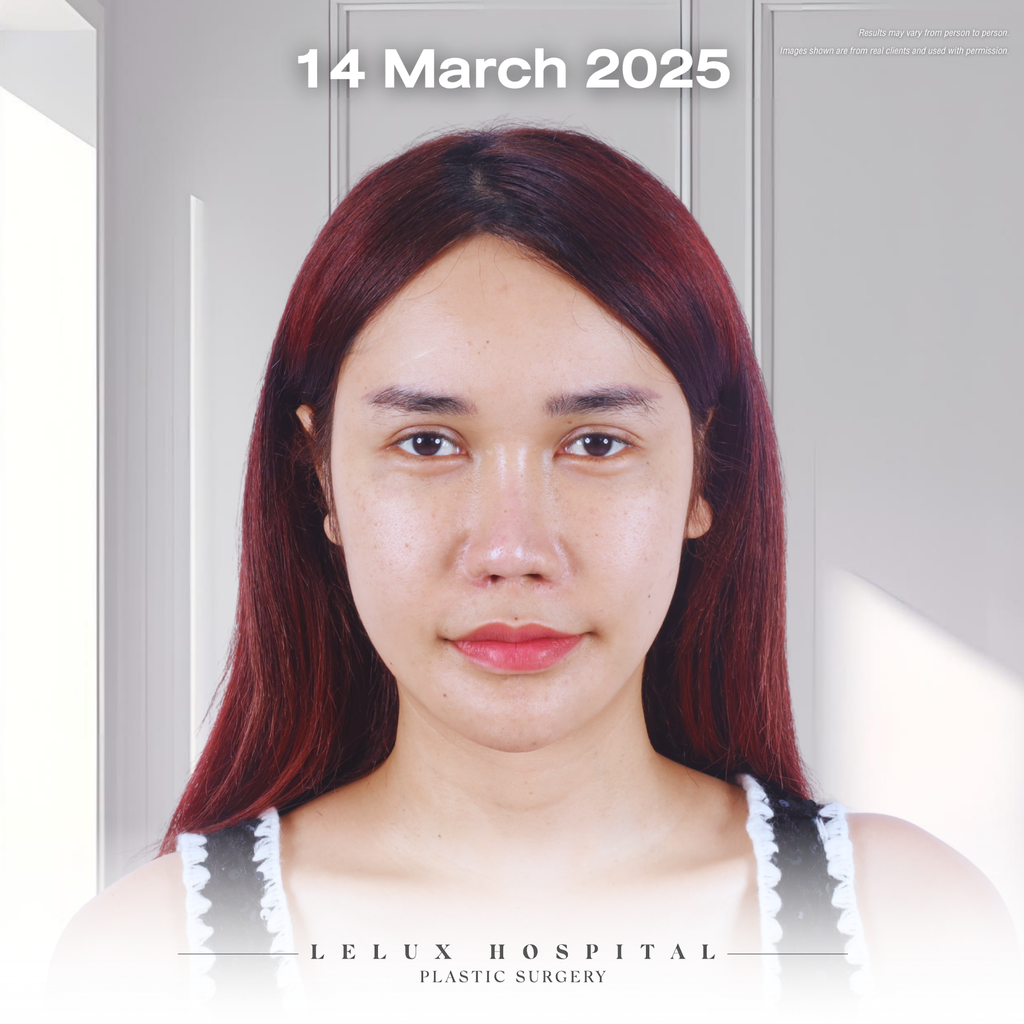
The case photographs document several stages throughout 2025, allowing changes in brow position and upper-facial balance to be observed over time.
Photographic checkpoints include:
- 14 March 2025
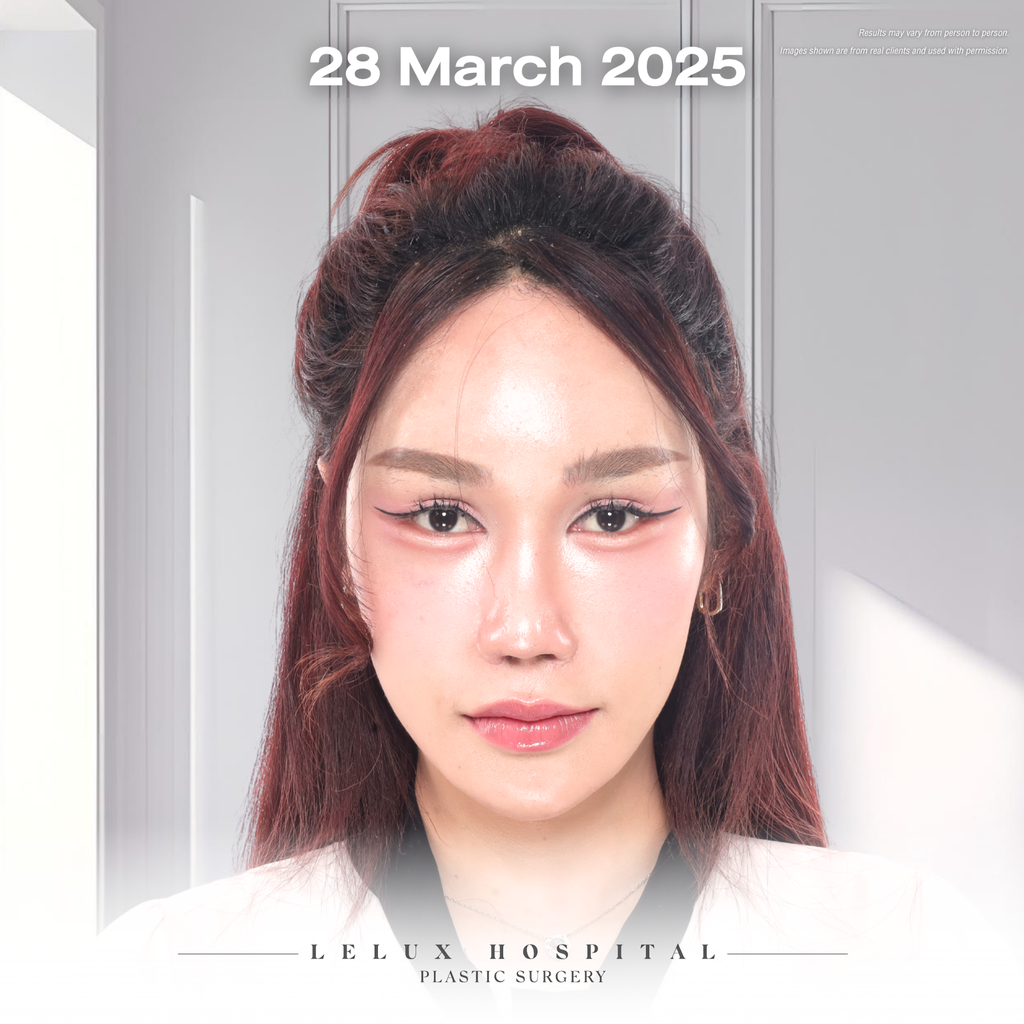
- 28 March 2025
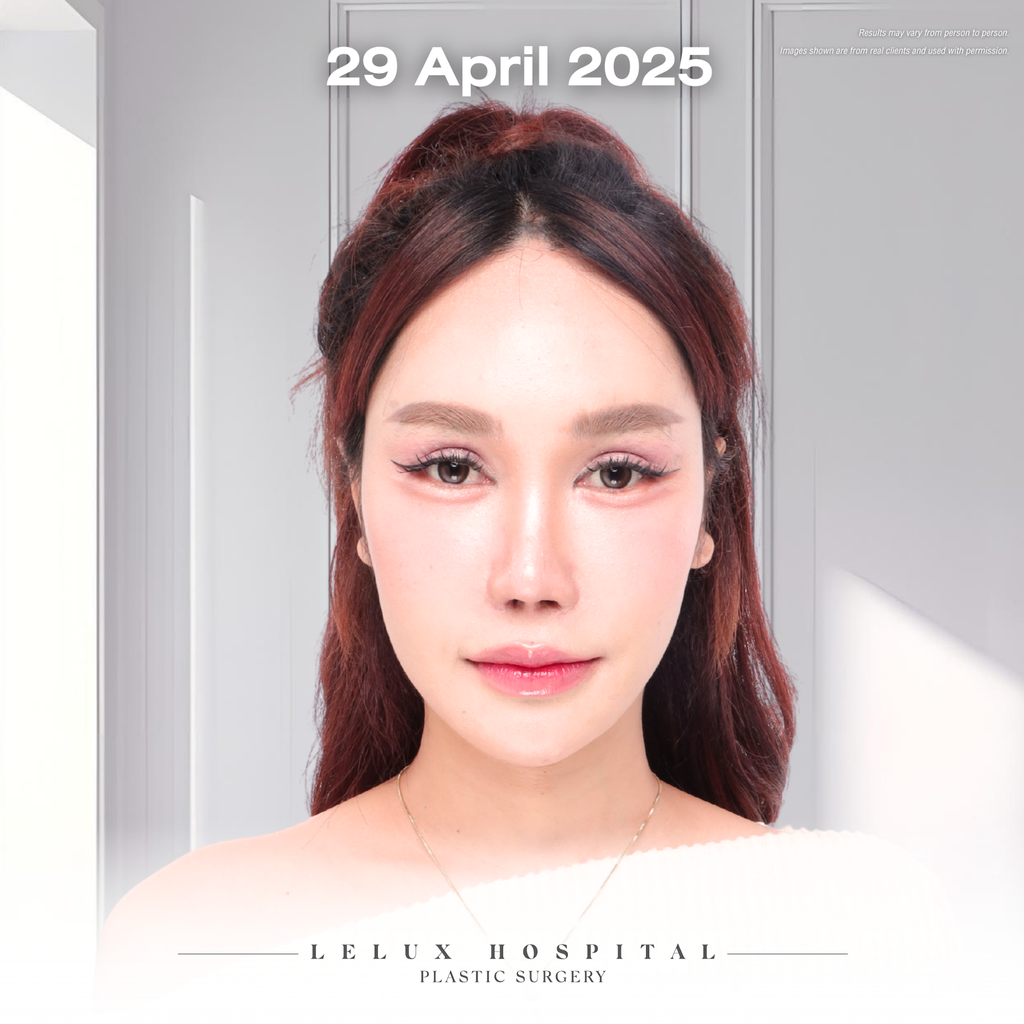
- 29 April 2025
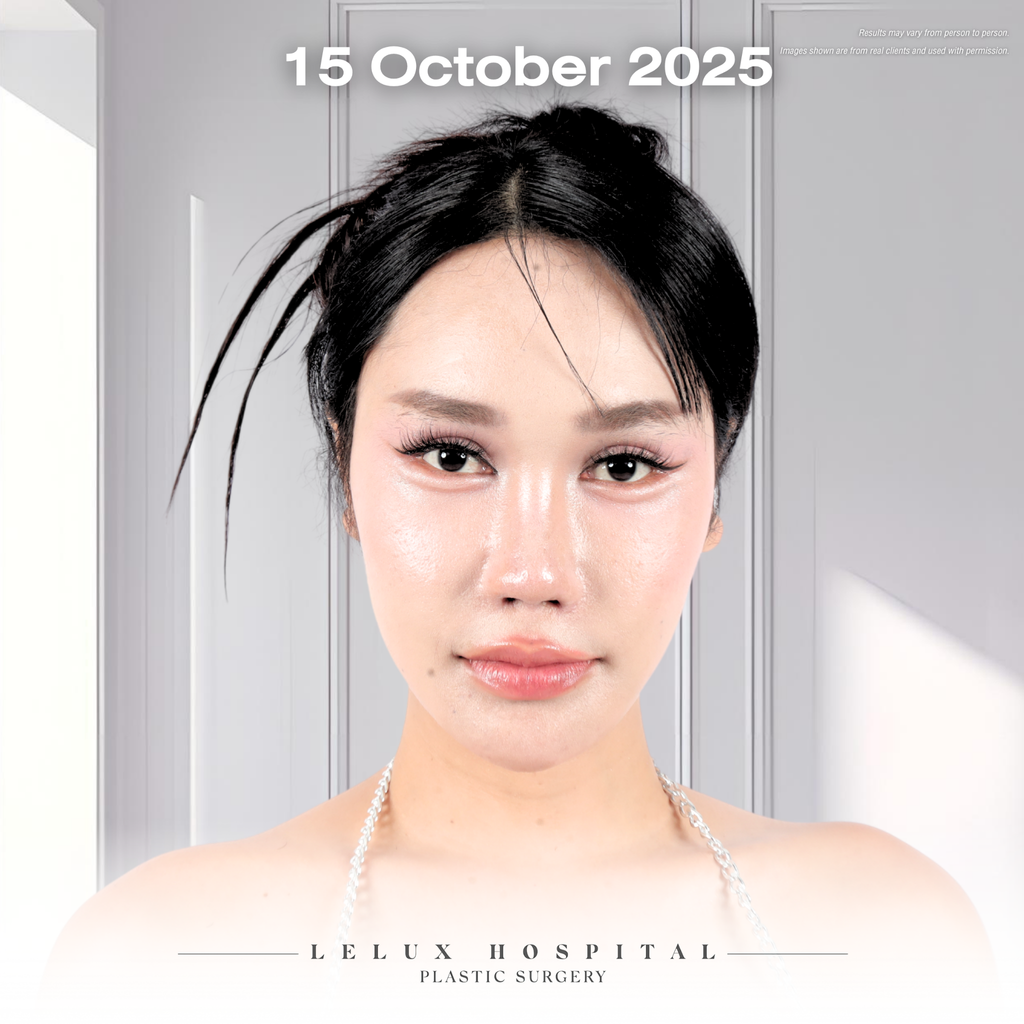
- 15 October 2025
When comparing the later photographs with the earlier images, changes can be observed around the brow and upper-eye area, including a more elevated appearance of the brows and greater openness around the upper eyelids.
The sequence also demonstrates how the appearance of the upper face may continue to evolve as swelling decreases and tissues settle over time.
Before-and-after photographs should always be interpreted carefully. Lighting, makeup, facial expression, hairstyle, camera distance, and angle may influence how facial features appear.
The images represent an individual patient’s experience and should not be interpreted as a guarantee of another patient’s result.
When Brow Position Influences the Upper Eye Area
The position of the eyebrows can influence the overall appearance of the upper face.
When the brows sit relatively low, patients may notice:
- Heaviness around the upper eyelids
- Reduced visibility of the eyelid crease
- A lower outer brow
- Brow asymmetry
- Eyes that appear less open
- A tired-looking upper facial expression
For younger adults, these concerns may be associated with natural facial anatomy rather than significant age-related skin laxity.
It is also important to recognize that upper-eyelid heaviness is not always caused by brow position.
Some patients may have excess upper-eyelid skin or other anatomical characteristics that require a different treatment approach.
Depending on the individual evaluation, treatment options may include:
- Brow lift surgery
- Upper blepharoplasty
- Another upper-face procedure
- A combination of procedures
For this reason, assessment should consider the brows, forehead, upper eyelids, hairline, and overall facial proportions together.
What Is an Endotine Brow Lift?
An Endotine Brow Lift is a surgical brow-lifting approach that uses a bioabsorbable fixation device to help support repositioned brow and forehead tissues during the healing period.
During surgery, the brow and forehead tissues are repositioned according to the individual treatment plan.
The Endotine device helps maintain the tissues in the selected position while biological healing gradually develops.
Rather than relying on a single fixation point, the system uses multiple contact points to distribute support across the tissue.
The device is designed to gradually absorb over time as the tissues heal.
However, Endotine itself does not determine the final eyebrow shape or aesthetic result.
The final appearance is influenced by several factors, including:
- Natural brow anatomy
- Brow height and position
- Forehead structure
- Hairline position
- Brow symmetry
- Skin and soft-tissue condition
- Amount and direction of tissue repositioning
- Surgical technique
- Individual healing response
- Patient expectations
Endotine should therefore be understood as one fixation option used during brow lift surgery, rather than a device that guarantees a particular brow shape or result.
Why Age Alone Should Not Determine Brow Lift Treatment
There is no single age at which someone automatically becomes suitable for brow lift surgery.
Two people of the same age may have very different facial structures.
One individual may naturally have higher brows and minimal upper-facial heaviness, while another may have lower-positioned brows, visible asymmetry, or upper-eyelid heaviness related to brow position.
For this reason, treatment planning generally considers:
- Facial anatomy
- Brow position
- Skin elasticity
- Forehead structure
- Brow-to-eyelid relationship
- Hairline
- Degree of asymmetry
- Patient concerns and expectations
For younger adults, individualized assessment is particularly important in determining whether surgical repositioning is appropriate or whether another treatment option may better address the concern.
Endotine Brow Lift vs Thread Lift
An Endotine brow lift and a thread lift are different procedures.
Endotine Brow Lift
An Endotine brow lift is a surgical procedure involving repositioning of the brow and forehead tissues.
An absorbable fixation device is used to support the repositioned tissues during healing.
Thread Lift
A thread lift uses lifting threads placed beneath the skin and does not involve the same type of surgical tissue repositioning performed during brow lift surgery.
The two approaches differ in:
- Surgical technique
- Degree of tissue repositioning
- Incisions
- Recovery
- Duration of improvement
- Suitability for different facial concerns
The most appropriate option depends on the patient’s anatomy and treatment goals.
Brow Lift vs Facelift: Different Areas, Different Goals
Although both procedures are part of facial rejuvenation surgery, they address different areas.
Brow Lift
A brow lift mainly focuses on:
- Forehead
- Eyebrow position
- Outer brow
- Upper facial area
Facelift
A facelift generally focuses on:
- Midface sagging
- Lower-face laxity
- Jowls
- Jawline definition
- Neck laxity in selected cases
For a younger patient whose primary concern involves brow position or the relationship between the brows and upper eyelids, treatment should focus on the actual anatomical concern rather than automatically extending to other areas of the face.
Who May Consider an Endotine Brow Lift?
Brow lift surgery may be considered in appropriately selected adults with concerns such as:
Naturally Low-Positioned Brows
Some individuals naturally have lower brows even without significant age-related changes.
Lower Outer Brows
A low outer brow may influence the balance between the eyebrows and eyes.
Brow Asymmetry
The two eyebrows may naturally sit at different heights or positions.
Upper-Eyelid Heaviness Related to Brow Position
In some cases, relatively low brows may contribute to a heavier appearance around the upper eyelids.
Desire for Structural Brow Repositioning
Some patients may consider a surgical approach when their goal involves structural repositioning rather than temporary lifting.
Interest in the procedure does not automatically mean that surgery is appropriate. Medical history, anatomy, skin condition, previous treatments, and expectations should all be evaluated before treatment.
Treatment Planning: The Goal Is Balance, Not Simply a Higher Brow
A brow lift should not be judged by how high the eyebrows can be raised.
The goal is to create a brow position that remains appropriate for the patient’s natural eyes, forehead, hairline, and overall facial proportions.
During consultation, assessment may include:
- Natural eyebrow shape
- Inner brow position
- Outer brow position
- Brow symmetry
- Upper-eyelid exposure
- Forehead height
- Hairline position
- Skin elasticity
- Previous aesthetic treatments
- Overall facial proportions
- Patient preferences
For younger adults in particular, maintaining recognizable facial characteristics is an important part of treatment planning.
Excessive elevation may create an unnatural or overly surprised appearance, which is why the amount and direction of lifting should be individualized.
How an Endotine Brow Lift Is Performed
The surgical technique varies according to facial anatomy and the treatment plan.
A general Endotine-assisted brow lift may include the following steps.
Step 1: Upper-Face Assessment
The surgeon evaluates the brows, forehead, upper eyelids, hairline, facial proportions, medical history, and treatment goals.
Photographs may also be taken for treatment planning.
Step 2: Pre-Operative Evaluation
Health assessment and laboratory testing may be required depending on the patient’s medical condition and planned procedure.
Patients should inform the medical team about:
- Existing medical conditions
- Current medications
- Vitamins and supplements
- Allergies
- Previous surgery
- Smoking
- Previous aesthetic procedures
Prescribed medication should not be stopped or adjusted without medical advice.
Step 3: Anesthesia
The type of anesthesia depends on the surgical technique, extent of treatment, and individual medical plan.
Step 4: Brow Repositioning
Depending on the surgical approach, incisions may be placed near or behind the hairline.
The brow and forehead tissues are carefully repositioned according to the planned direction and degree of lifting.
Step 5: Endotine Fixation
When Endotine is selected, the fixation device helps support the repositioned tissue during the healing period.
Step 6: Closure and Recovery
After the tissues are positioned appropriately, the incisions are closed and the patient enters postoperative monitoring and recovery.
Recovery After Endotine Brow Lift
Recovery varies from person to person.
During the early stage, patients may experience:
- Swelling
- Bruising
- Forehead tightness
- Temporary numbness
- Changes in sensation
- Tenderness around incision areas
- Mild to moderate discomfort
Initial wound healing may commonly take approximately 10–14 days, although swelling and tissue adjustment may continue beyond this period.
The brow position and surrounding tissues may continue to settle over the following weeks or months.
Patients should follow individual medical instructions regarding:
- Head elevation
- Incision care
- Medication
- Hair washing
- Exercise
- Physical activity
- Avoiding unnecessary pressure around the treated area
- Follow-up appointments
What Can Be Observed in Basty’s Case?

When comparing the later case photographs with the earlier images, visible changes in this individual case include:
- A more elevated brow appearance
- Greater openness around the upper eye area
- A clearer relationship between the brows and eyes
- Improved overall balance of the upper face
The photograph dated 15 October 2025 provides a later visual reference after the tissues had more time to settle compared with earlier photographs.
For someone in her late 20s, the purpose of treatment is particularly important to understand.
The goal is not necessarily to make the patient appear significantly younger. Instead, treatment may focus on brow position, proportion, upper-eye openness, and balance across the upper face.
This distinction helps explain why some younger adults may consult about brow lift surgery even without advanced signs of facial aging.
How Long Do Brow Lift Results Last?
Brow lift surgery involves structural repositioning of tissue and may provide longer-term improvement compared with temporary non-surgical treatments.
However, results are not permanent.
The face continues to change naturally over time.
The longevity of results can be influenced by:
- Skin elasticity
- Facial anatomy
- Age
- Surgical technique
- Genetics
- Sun exposure
- Smoking
- Lifestyle
- Weight fluctuations
- Natural aging
For this reason, it is more appropriate to describe brow lift surgery as providing long-term improvement that varies between individuals, rather than promising a fixed duration.
Risks and Important Considerations
Brow lift surgery carries potential risks, as with any surgical procedure.
Possible complications may include:
- Bleeding
- Hematoma
- Infection
- Scarring
- Delayed wound healing
- Temporary or persistent numbness
- Changes in forehead or scalp sensation
- Brow asymmetry
- Changes in brow position
- Hairline changes
- Hair loss around incision areas
- Facial nerve injury
- Anesthesia-related complications
- Need for additional treatment or revision
For younger adults, the decision to undergo surgery should be based on a clearly identified anatomical concern, an individualized medical assessment, and realistic expectations.
A consultation is necessary to determine whether brow lift surgery is suitable or whether another treatment approach may be more appropriate.
The photographs shown represent one individual patient’s experience. Results, scars, brow position, healing, and recovery time vary from person to person.